

Infrared spectroscopy sheds new light on the future of protonic ceramic cells
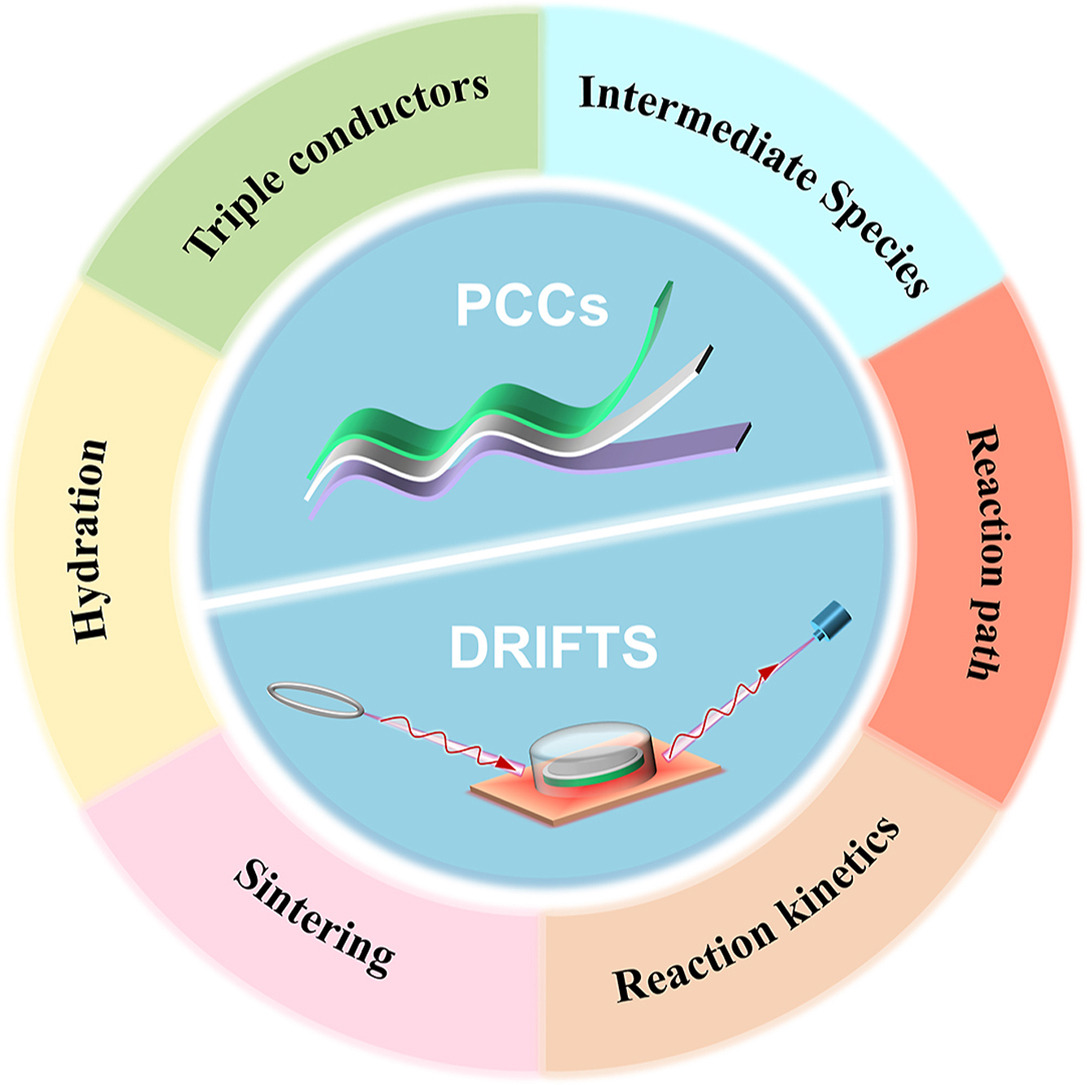
DRIFTS as a Window into Protonic Ceramic Cell Surface Chemistry.
GA, UNITED STATES, February 5, 2026 /EINPresswire.com/ -- Protonic ceramic cells (PCCs) are emerging as highly efficient devices for power generation, hydrogen production, and chemical synthesis at intermediate temperatures. However, their advancement depends on a deeper understanding of proton transport, hydration mechanisms, and surface catalytic reactions. This review highlights how diffuse reflectance infrared Fourier transform spectroscopy (DRIFTS) provides a powerful, surface-sensitive approach to uncover these mechanisms in real time. By probing hydroxyl formation, carbonate species, reaction intermediates, and proton migration pathways, DRIFTS enables researchers to decode key phenomena that govern PCC performance. The study also outlines major challenges and proposes strategies to expand DRIFTS capabilities for improving materials design and accelerating PCC development.
With the global shift toward renewable energy, solid oxide–based electrochemical devices have become essential for hydrogen production, energy storage, and fuel-to-electricity conversion. Traditional oxygen-ion–conducting cells require high operating temperatures, creating cost, durability, and material compatibility challenges. Protonic ceramic cells (PCCs) offer an alternative, operating efficiently at 300–600 °C and allowing the use of cheaper components, improved thermal cycling, and enhanced stability. Despite rapid progress in materials engineering, the fundamental mechanisms governing hydration, proton conduction, and electrode reactions remain insufficiently understood. These gaps hinder rational catalyst design and slow the translation of new materials into practical PCC devices. Based on these challenges, there is a critical need to deeply investigate proton behavior, interfacial chemistry, and catalytic mechanisms.
Researchers from Idaho National Laboratory and collaborating universities published a comprehensive review on August 2025, in eScience, detailing how diffuse reflectance infrared Fourier transform spectroscopy (DRIFTS) is transforming protonic ceramic cell research. The article summarizes recent breakthroughs in applying DRIFTS to oxygen electrodes, proton-conducting electrolytes, and hydrogen electrodes under realistic operating conditions. By capturing surface intermediates and hydration signatures, the review highlights DRIFTS as an essential technique for understanding reaction pathways, improving proton uptake, and guiding next-generation materials design for high-performance PCC systems. This platform was recently reported in a research article by the same group in Energy Environmental Science, providing the substantial evidence on how it is powerful in electrochemical system at elevated temperatures, specifically for PCC.
The review outlines how DRIFTS enables direct observation of surface species and dynamic reactions across PCC components. For oxygen electrodes, DRIFTS detects hydroxyl stretching bands associated with proton uptake, providing insights into triple-conducting materials such as PrNi₀.₅Co₀.₅O₃–δ, PrBaCo₂O₅+δ, and high-entropy perovskites. Doping-induced enhancements—such as Zn-stabilized hydration sites or Cs-driven oxygen vacancy formation—are revealed through stronger –OH peaks and temperature-dependent hydration behavior. DRIFTS also verifies steam-induced structural transformations, including monoclinic-to-cubic transitions and the emergence of multi-phase composites that improve catalytic performance.
For protonic electrolytes, DRIFTS distinguishes Zr–OH–Zr and Zr–OH–X environments, enabling researchers to identify proton trapping, dehydration kinetics, and dopant-dependent hydrogen-bonding effects in materials like Sc- and Y-doped BaZrO₃. The technique further detects carbonate residues that impair sintering, guiding optimized fabrication routes.
In catalytic applications, DRIFTS captures intermediates during CO₂ hydrogenation, methane reforming, and chemical-fuel co-conversion, identifying formates, carbonates, and CO adsorption species crucial to mechanistic understanding. Emerging operando DRIFTS configurations with applied voltage demonstrate the movement of surface protons during real electrochemical reactions, validating proton migration and reaction coupling at electrode interfaces. Collectively, the review shows how DRIFTS bridges fundamental chemistry with practical PCC engineering.
According to the authors, DRIFTS provides a uniquely powerful lens for understanding how PCC materials behave under realistic conditions. They emphasize that the ability to monitor hydration, proton uptake, and catalytic intermediates in real time offers insights unavailable from traditional characterization tools. The authors note that integrating DRIFTS with complementary methods—such as synchrotron-based IR, X-ray spectroscopy, and computational modeling—will further expand its impact. They conclude that establishing operando DRIFTS systems capable of applying electrical load represents a critical next step for unraveling the complex, surface-driven processes that dictate PCC performance.
The review underscores that advancing DRIFTS techniques will accelerate the rational design of PCC materials for clean-energy technologies. Improved understanding of hydration behavior and proton migration can guide the development of durable oxygen electrodes, CO₂-tolerant electrolytes, and carbon-resistant hydrogen electrodes. Insights into reaction intermediates also support catalyst optimization for hydrogen production, CO₂ reduction, methane reforming, and value-added chemical synthesis. As energy systems evolve toward efficiency and sustainability, DRIFTS-enabled mechanistic knowledge will help bridge laboratory discoveries and scalable PCC devices. Ultimately, the authors note that expanding operando DRIFTS capabilities will be essential for building the next generation of robust, high-performance ceramic energy systems.
References
DOI
10.1016/j.esci.2025.100437
Original Source URL
https://doi.org/10.1016/j.esci.2025.100437
Funding information
This work is supported by the HydroGEN Advanced Water Splitting Materials Consortium, established as part of the Energy Materials Network under the U.S. Department of Energy (USDOE); the Office of Energy Efficiency and Renewable Energy (EERE); and the Hydrogen and Fuel Cell Technologies Office (HFTO), under DOE Idaho Operations Office, under contract no. DE-AC07-05ID14517.
Lucy Wang
BioDesign Research
email us here
Legal Disclaimer:
EIN Presswire provides this news content "as is" without warranty of any kind. We do not accept any responsibility or liability for the accuracy, content, images, videos, licenses, completeness, legality, or reliability of the information contained in this article. If you have any complaints or copyright issues related to this article, kindly contact the author above.
